

Junee Hotel & The Railway Story | Historic Railway Hotel
Built by Rail. Shaped by Travel. Still welcoming today.
In the heart of Junee NSW, one of Australia’s great railway towns, stands the historic Junee Hotel - a hotel whose story is inseparable from the rise of the New South Wales railway network, the growth of the Riverina and the golden age of rail travel in Australia.
Established in 1878 as the Railway Hotel, the Junee Hotel was built during one of the most significant railway expansion periods in Australian history. At the very moment the Main Southern Railway transformed Junee into a major railway junction between Sydney and Melbourne, the hotel emerged to serve railway workers, passengers, freight operators, farmers and travellers moving through regional New South Wales.
From the beginning, Junee Hotel was more than a pub - it was a became part of the railway itself and gateway for rail workers, travellers, farmers, business operators and visitors arriving in Junee during the golden age of steam.

_JPG.jpg)


%20-%20Copy.jpg)
Year
1876
Railway Milestone
Christopher Crawley buys land near planned Main South railway route.
Junee Hotel & Heritage story
Crawley subdivides townsite in anticipation of the line, planning a hotel to serve the new railway settlement.
6 July 1878
3 Sep 1878
1881
1882
Junee station opens as temporary terminus of Main South line from Bethungra.
January - Railway Hotel opens as Junee’s first commercial building, before bank, post office or bakery. Built by Crawley opposite the station. Serves as railway ticket office before station facilities complete.
Hotel serves railway crews, passengers and workers; acts as unofficial railway office before permanent station facilities.
Line extends from Junee Junction to Bomen (North Wagga).
Hay/Narrandera branch opens from Junee; station renamed Junee Junction.
Original timber rail station burns down.
Railway Hotel becomes social hub for junction crews servicing Main South and western branches.
Hotel continues as main refreshment and accommodation point near the line.
1883 - 1885
John Whitton designs new brick station; opens 5 March 1885 with refreshment rooms.
Railway Hotel shares passenger trade with new on‑station facilities but remains town’s premier pub.
1880's
decade
Workshops move from Wagga to Junee; town grows as major rail centre.
Hotel hosts expanding railway workforce, commercial travellers and locals; early editions of Southern Cross newspaper printed in shed at back.
1884
Crawley sells hotel to fund Monte Cristo Homestead.
Crawley sells Railway Hotel to fund Monte Cristo Homestead construction - “Australia’s most haunted house” overlooking Junee.
1908
Mrs E. O’Donnell, licensee, advertises Railway Hotel’s wines, spirits and stabling for railway horses.
1911 -
1912
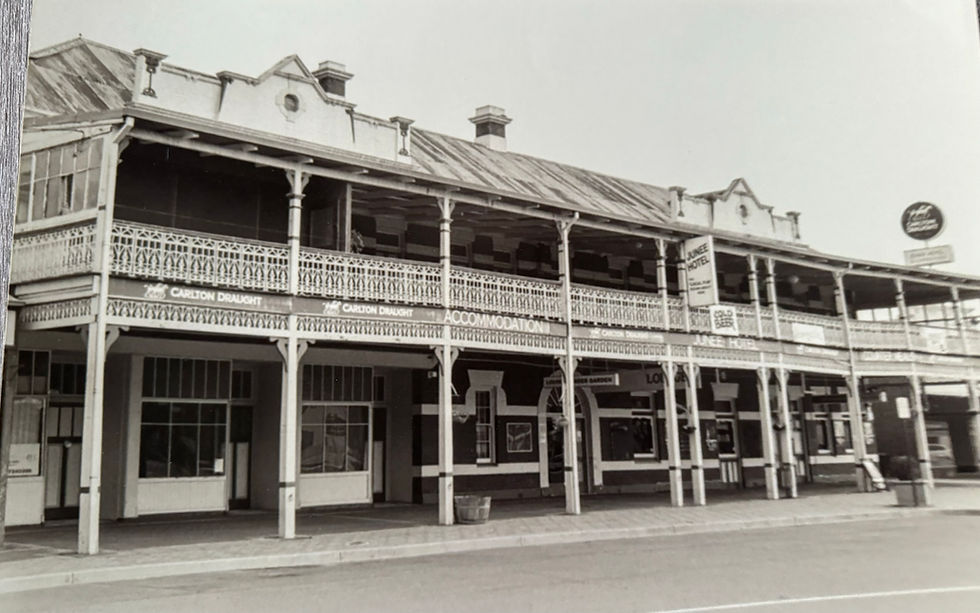
Original hotel replaced by current Art Nouveau/Federation Filigree building, designed by William Monks for Mrs E. O’Donnell. High ceilings, cast iron details reflect railway boom.
1920
Hotel cycles through ~10 licensees, including “Condon’s Railway Hotel” (c.1921–1923)
1930's
Hotel hosts first Light Horse Brigade meetings & serves passengers on Main South expresses.
1940's
Introduction of Southern Aurora & Southern Highlands passenger services that connect Junee with major cities, increasing tourism.
30 April, 1946, The Railway Hotel changed it's name to Junee Hotel.
Hotel continues as railway town landmark.
1943 -
1947
Junee roundhouse (42‑road loco depot) construction begins; opens Sep 1947 - largest in southern hemisphere.
Hotel serves roundhouse crews and junction traffic at height of steam era.
1950's
Expansion of the roundhouse and servicing facilities due to increased rail traffic post-WWII.
Hotel accommodates crews during roundhouse peak.
1960's
Dieselisation; steam facilities (coal stages, ash pits) removed from roundhouse.
Hotel adapts to changing rail workforce.
1993
Junee locomotive depot closes as State Rail facility.
Junee shifts to rail heritage tourism.
1994
Roundhouse leased by Junee Council; becomes Junee Roundhouse Railway Museum + commercial workshop.
2020's
Junee Roundhouse Railway Museum thrives;
XPT and NSW TrainLink services continue.
Reynolds family restore hotel.
.jpg)
Built for the Railway Era
When the railway arrived in Junee in 1878, the town rapidly transformed into one of the most important rail centres in NSW. The original Railway Hotel was constructed opposite the station before many of Junee’s earliest commercial buildings, including the bank and post office.
The Junee Hotel was established to support the growing rail industry and quickly became known for:
-
housing railway workers and travelling passengers
-
served meals and refreshments for rail crews
-
operated as an early railway ticket office before station facilities were completed
-
became a social and business hub for the growing railway settlement
As steam trains connected Sydney, Melbourne and the Riverina, the Railway Hotel became one of the busiest and most important buildings in town.
Junee NSW became one of the most significant railway centres in Australia due to its strategic location on the Main Southern railway corridor.
Railway history attractions in Junee include:
-
Junee Roundhouse Museum
-
Historic Junee Railway Station
-
Bethungra Spiral
-
XPT rail services
-
Railway heritage precincts
-
Steam locomotive history
-
Rail photography locations
Today, Junee remains one of regional NSW’s leading railway tourism destinations.
Junee Railway history


The Junee Roundhouse Museum is one of Australia’s most important railway heritage attractions.
Built during the steam rail era, the Roundhouse preserves:
-
Historic locomotives
-
Railway workshops
-
Steam and diesel rail history
-
Railway engineering heritage
-
NSW rail operations history
Rail enthusiasts and railway photographers from across Australia visit Junee to experience this iconic railway landmark.
Bethungra Rail spiral & photography
Located near Junee NSW, the famous Bethungra Spiral is one of Australia’s best-known railway engineering sites and a major attraction for rail tourism and rail photography.
Combined with:
-
Active freight rail traffic
-
XPT passenger trains
-
Historic rail infrastructure
-
Scenic Riverina landscapes
Junee has become a recognised destination for railway photography in Australia.


Historic Junee Railway Station & XPT
The heritage-listed Junee Railway Station remains an active station on the Sydney to Melbourne rail corridor and continues to service NSW TrainLink XPT passenger trains.
Its ongoing rail connection reinforces Junee’s identity as one of NSW’s great railway towns.
The Junee Hotel remains centrally located near the station and continues its long tradition of welcoming rail travellers visiting regional NSW.
Federation Heritage Architecture
The current Junee Hotel building was rebuilt in 1911–1912 in a striking Federation Filigree and Art Nouveau style.
Historic features include:
-
Ornate iron lace verandahs
-
Decorative heritage facades
-
Pressed metal ceilings
-
Traditional country pub architecture
-
Historic streetscape character
Today, the Junee Hotel remains one of Junee NSW’s most recognised heritage buildings.

.jpg)
Railway heritage lives on
From the steam locomotive era to modern XPT rail travel, the Junee Hotel has remained connected to Junee’s railway history for nearly 150 years.
Today the hotel continues to welcome:
-
Railway enthusiasts
-
Rail photographers
-
Heritage travellers
-
XPT passengers
-
Riverina tourists
-
Visitors exploring regional NSW
The Junee Hotel is more than a country pub - it is part of the railway history and heritage of Junee NSW.